
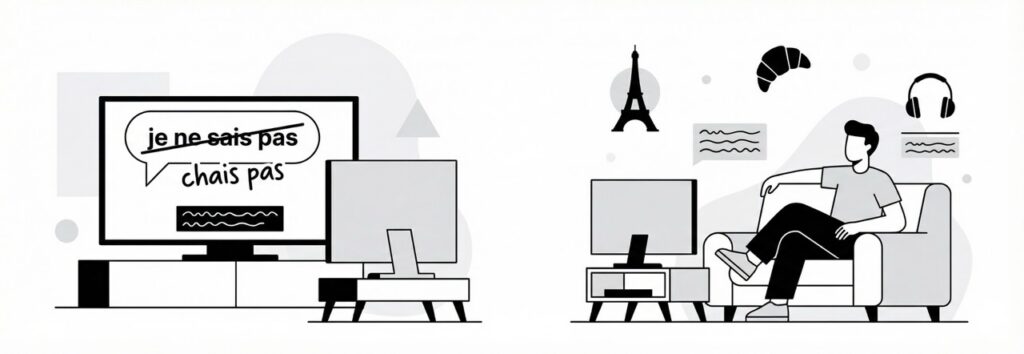
French is one of those languages where you can study for years and still freeze the first time a real person talks to you. You know the grammar. You’ve memorized the vocabulary. You can read a menu. But then someone in a café says “Chuis pas sûr, j’crois qu’y a plus de croissants” and your brain short-circuits—because that sentence doesn’t exist in any textbook you’ve ever opened.
That gap between textbook French and real French is exactly what Netflix fixes. Not the grammar, not the conjugation tables—but the sound of the language as it’s actually spoken. The dropped syllables, the swallowed words, the filler expressions, the way French people string sentences together at a speed that makes your Duolingo exercises feel like a cruel joke.
This guide is specifically about French. Not “any language”—French. Because French has its own particular set of challenges for listening comprehension, and Netflix happens to be one of the best tools for tackling them. If you’re looking for the general method (subtitle strategy, daily routine, common mistakes), we’ve covered that in our complete Netflix language learning guide. This article goes deeper into what makes French specifically hard to understand—and how to use Netflix to get past it.
Why French sounds impossible (and why that’s actually normal)
If you’ve ever felt like French people are speaking at twice the speed of any other language, you’re not imagining it. French is objectively one of the fastest spoken languages in terms of syllables per second. But the real problem isn’t speed—it’s three things that French does differently from most languages you might be used to.
1. Words run into each other
In English, there are tiny pauses between words. In French, there aren’t. The phenomenon is called enchaînement and liaison: consonants at the end of one word attach to the vowel at the beginning of the next. “Les enfants” doesn’t sound like “lay on-fon”—it sounds like “lay-zon-fon.” “Vous avez” becomes “voo-za-vay.” Your brain, trained to hear word boundaries, gets nothing to grab onto.
This is why beginners often say “it all sounds like one long word.” It literally does. And no amount of vocabulary study prepares you for it—you need to hear it, hundreds of times, in real context. That’s what Netflix provides.
2. Spoken French is a different language from written French
This isn’t an exaggeration. When French people actually talk, they do things that would get you marked wrong on a test:
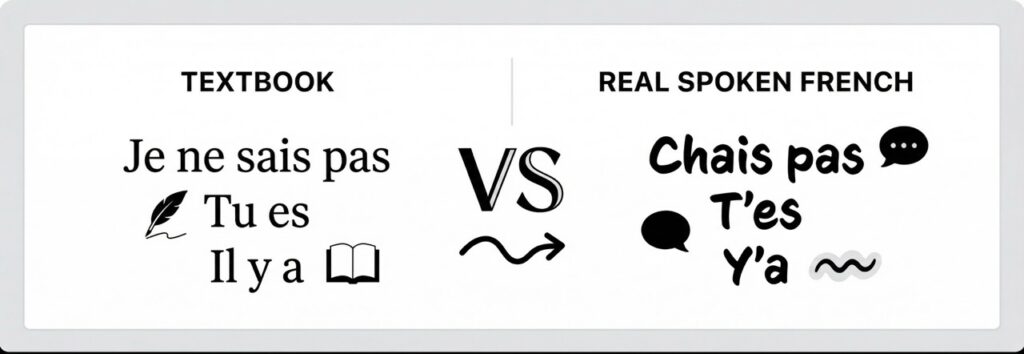
- They drop the “ne” in negation. Textbook: “Je ne sais pas.” Real life: “J’sais pas” or even “Chais pas.” The ne essentially doesn’t exist in casual speech.
- They contract everything. “Tu es” becomes “t’es.” “Tu as” becomes “t’as.” “Il y a” becomes “y’a.” “Je suis” becomes “chuis.”
- They use filler words constantly. “Bah,” “ben,” “euh,” “quoi,” “hein,” “enfin,” “du coup,” “genre”—these words carry almost no literal meaning but they’re in every single sentence. If you don’t recognize them, they sound like content you’re failing to understand.
- They use informal vocabulary. “Bosser” instead of “travailler” (to work). “Bouffer” instead of “manger” (to eat). “Flic” instead of “policier” (cop). “Mec” instead of “homme” (guy).
Netflix shows you this French—the one people actually speak. And the more you hear it, the less alien it sounds.
3. The accent challenge
French has sounds that simply don’t exist in English: the nasal vowels (an, on, in, un), the French u (as in tu—different from ou), the guttural r. You can study these in isolation, but learning to recognize them in flowing speech is a different skill entirely. Netflix trains that skill passively—your ear gradually learns to parse these sounds in real conversation, at real speed, in real emotional contexts.
What Netflix teaches you that textbooks can’t
The reason Netflix works for French isn’t just “more listening practice.” It’s that French TV exposes you to specific things that structured courses systematically avoid.
Register switching
French has a much sharper distinction between formal and informal registers than English does. A character negotiating in an office uses vous, subjunctive, full negations, and careful vocabulary. The same character at home with friends uses tu, drops every ne, swears, and speaks 30% faster. Netflix shows this shift constantly, and over time your brain starts mapping which register fits which situation—something a textbook can explain but never demonstrate.
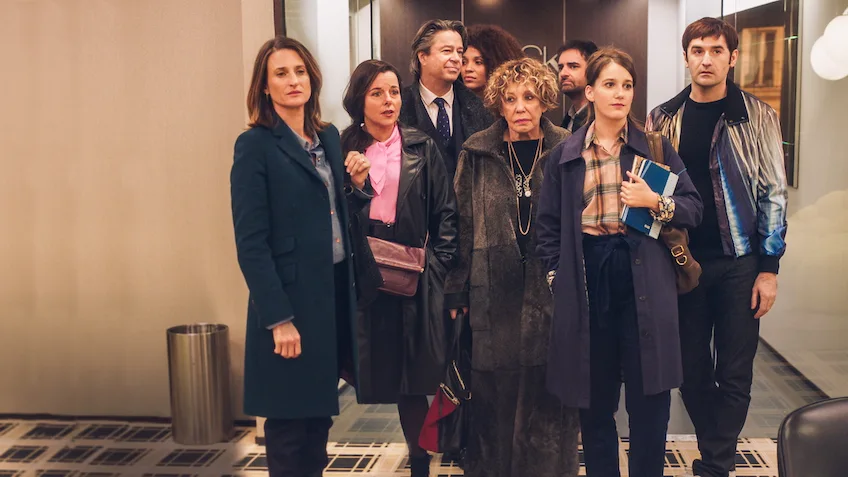
Watch Dix pour cent (Call My Agent!) and you’ll hear both registers in every single scene: agents speaking polished French to celebrity clients, then switching to raw, fast, emotional French among themselves.
Cultural context you can’t Google
When a character says “C’est n’importe quoi,” the literal translation is “it’s anything”—which makes no sense. The real meaning is closer to “that’s ridiculous” or “what a mess.” When someone says “J’en ai marre,” they’re not saying they have a pond (mare)—they’re saying “I’m fed up.” When a Parisian teenager says “C’est chanmé,” that’s verlan (backslang) for “c’est méchant”—but it means “that’s awesome.”
These expressions live in context. Netflix gives you the context: the facial expression, the tone, the reaction of the other characters. That’s how your brain learns to decode them—not through a dictionary entry, but through seeing what happens when someone says it.
The rhythm of conversation
French conversations don’t follow the same patterns as English ones. People interrupt more. They layer short interjections (“ah bon?” “mais non” “c’est vrai?” “n’importe quoi”) over each other. They use rising intonation for questions instead of inverting subjects. They signal agreement with “voilà” and “exactement” and “c’est ça” in ways that have no clean English equivalent.
You can’t learn conversational rhythm from a textbook. You absorb it by watching real conversations—and then one day, without realizing it, you start expecting the interjections, anticipating the rhythm, and understanding more because you know how French conversations move.
The French-specific Netflix method
The general subtitle strategy (target-language subtitles, don’t pause too much, rewatch scenes) works for any language. But for French specifically, here are adjustments that make a real difference.
Use French subtitles, not English ones—earlier than you think
With most languages, learners debate when to switch from native-language subtitles to target-language ones. With French, the answer is: as soon as possible. French spelling is far more regular and phonetic than English, and seeing the written form while hearing the spoken form is uniquely helpful for French because it trains you to decode all those liaisons and contractions.
When you read “les enfants” while hearing “lay-zon-fon,” your brain makes the connection. When you read “je ne sais pas” while hearing “chais pas,” your brain maps the formal to the informal. These connections only happen with French subtitles—English subtitles teach you nothing about how French is structured.
If French subtitles feel too hard right now, tools like Bingy can help bridge the gap: they show French subtitles when you can handle them and switch to English only when a subtitle is genuinely beyond your level—so you stay in French as much as possible without drowning.
Focus on one show at a time (more than you would with other languages)
French has a wider range of registers and accents than most learners expect. If you jump between a Parisian comedy, a Marseille crime drama, and a Québécois film in the same week, your ear will struggle to calibrate. Each show has its own speech patterns, speed, slang, and accent.
Pick one show. Watch at least a full season. Let your ear settle into that version of French. Once it becomes comfortable, switch to something different—and notice how your brain adapts faster each time.
Listen for the “invisible” words
French is full of tiny words that carry enormous meaning but are easy to miss because they’re short and unstressed: en, y, le, lui, dont, quand même, du coup, en fait, par contre. These words are the connective tissue of French—they hold sentences together. When you start hearing them, your comprehension jumps.
Try this: pick a scene you’ve already watched and rewatch it listening only for connector words. You’ll be surprised how many you recognize once you’re actively tuning in.
7 French Netflix shows that teach you different kinds of French
You don’t just need “good” shows—you need shows that expose you to different types of French. Here’s a curated selection that covers the full spectrum, from gentle beginner content to advanced street French.
For the complete list with detailed breakdowns, see our full guide to French shows on Netflix.
For getting started: Chef’s Table France
Slow, clear narration over beautiful food visuals. Documentary French is the closest thing to textbook French that actually exists in the wild—measured pacing, complete sentences, minimal slang. This is where you calibrate your ear before jumping into anything scripted.
For everyday conversation: Plan Cœur (The Hook Up Plan)
Three friends, a Paris apartment, dating disasters. The dialogue is exactly how young Parisians talk to each other: fast, peppered with “du coup,” “j’en ai marre,” “c’est pas vrai,” and casual contractions everywhere. This is the French you need if you actually want to talk to French people someday.
For professional + casual French: Dix pour cent (Call My Agent!)
The best show for hearing the difference between formal and informal French. Agents switch between polished client-facing French and raw, emotional backstage conversations. You get vouvoiement and tutoiement in the same scene. Four seasons, consistently excellent.
For clear, engaging dialogue: Lupin
Omar Sy speaks some of the clearest French on Netflix. His pacing is deliberate, his vocabulary is rich but not academic, and the heist storylines keep you watching. This is arguably the single best show for B1 learners—hard enough to challenge you, clear enough that you actually catch things.
For modern, young French: Drôle (Standing Up)
Stand-up comedy sets where comedians speak directly to the audience—clear enunciation, punchy language, modern slang. Between the sets, you get natural dialogue about ambition and relationships in contemporary Paris.
For multicultural Parisian French: Family Business
A Jewish-Moroccan family arguing about everything. You hear how French sounds when it’s mixed with cultural references, family dynamics, and intergenerational tensions. Informal, fast, funny—and very representative of what multicultural Paris actually sounds like.
For advanced/street French: Caïd (Dealer)
Verlan, argot, southern French accents, found-footage chaos. This is the hardest French on Netflix. If you can follow Caïd, you can follow anything. Keep episodes short (20 min) and don’t expect to understand everything—even native French speakers miss things in this show.
Common French-specific mistakes when watching Netflix
Trying to understand every word
French has so many contracted, elided, and swallowed syllables that even advanced learners miss individual words regularly. This is normal. Focus on understanding the meaning of each scene, not transcribing every syllable. If you understood the situation, the emotion, and the general point—you’re learning.
Ignoring filler words
“Bah,” “ben,” “euh,” “quoi,” “enfin,” “du coup,” “en fait,” “genre.” Beginners filter these out as noise. But they’re not noise—they’re the fabric of spoken French. Start paying attention to when and how characters use them, and your spoken French will immediately sound more natural.
Only watching Parisian French
Paris dominates French media, and most Netflix shows feature standard Parisian accents. But French is spoken across 29 countries, and even within France, accents vary enormously—Marseille, Lyon, the North, Brittany all sound different. Once you’re comfortable with Parisian French, deliberately seek out shows with different accents. Into the Night (Belgian production) is a good bridge.
Reading the subtitles instead of listening
This is especially tempting with French because the written form is so different from the spoken form. Your eyes want to read “je ne sais pas” while your ears hear “chais pas” and your brain decides reading is easier. Force yourself to listen first. Use the subtitles as a safety net, not a primary input channel. If you catch yourself reading more than listening, try covering the bottom of the screen for 30 seconds at a time.
How long until you understand French Netflix without subtitles?
There’s no magic number, but here’s a realistic progression assuming 20 minutes of French Netflix per day:
Weeks 1–3: You catch individual words and common phrases. You can tell when characters are happy, angry, or joking based on tone even when you miss the words. The filler words (“du coup,” “en fait”) start standing out.
Weeks 4–8: You follow the general plot of most scenes. You start recognizing the same expressions across different shows. The contractions (“chuis,” “t’as,” “y’a”) stop sounding like gibberish and start sounding like French.
Months 3–5: You understand most everyday dialogue. You catch jokes. You notice when characters switch registers. You start having opinions about characters’ speech habits. Watching becomes genuinely enjoyable.
Month 6+: You can rewatch shows you started with and realize you understand dramatically more. You catch subtleties you had no idea you were missing. You start watching some content without subtitles and actually following it.
This timeline assumes you’re combining Netflix with some other study (even casual—a grammar app, a conversation tutor, reading). Netflix alone will get you listening comprehension, but pairing it with even 15 minutes of active study per day accelerates everything.
FAQ
Is French hard to learn by watching Netflix? French is one of the harder languages for listening comprehension because of liaisons, contractions, and the gap between written and spoken forms. But that’s precisely why Netflix is so valuable—it gives you massive exposure to real spoken French, which is the only way to bridge that gap. Start with documentaries or slow-paced shows, and work your way up.
Should I watch French shows dubbed or original? Always original. French dubs of English shows are technically correct but they sound unnatural—the rhythm is off, the lip sync is distracting, and the vocabulary is flatter. Original French content gives you authentic speech patterns, real slang, and natural emotional delivery. The only exception: rewatching a show you already love in English with French dubbing can work because you already know the plot.
Can I learn French from Netflix if I’m a complete beginner? You’ll struggle with scripted shows at A1 level. Start with documentaries (Chef’s Table: France), reality shows (C’est du Gâteau), or shows you’ve already seen in English with French audio. The goal at this stage isn’t to understand everything—it’s to get your ear used to the sounds of French. Combine with a structured course for best results.
What’s the best French accent to learn from Netflix? Start with standard Parisian French (most Netflix shows use this). It’s the most widely understood and the closest to what language courses teach. Once comfortable, branch out—Marseille for southern accents, Belgian productions for Belgian French. All varieties are valid, but Parisian gives you the broadest base.
How is learning French with Netflix different from learning Spanish or German? French has a uniquely large gap between its written and spoken forms—larger than Spanish, German, or Italian. This means French subtitles are especially valuable because they help you map the sounds you hear to the words you know. The liaison and contraction systems also mean you need more listening hours before French “clicks” compared to more phonetically transparent languages.
The real point
The reason Netflix works for French isn’t that it’s magic—it’s that French has a massive gap between what textbooks teach and what people actually say, and the only way to close that gap is to hear real French, in real contexts, for enough hours that your brain rewires itself.
Every episode is an hour where your brain processes authentic French—liaisons, contractions, filler words, register switches, and all the messy, beautiful reality of a language that 300 million people speak every day. You won’t understand everything. You don’t need to. You just need to keep showing up.
For subtitle support that adapts to your vocabulary level automatically, try Bingy—it keeps subtitles in French when you can handle them and switches to English only when you’d otherwise be lost. And for the full list of what to watch, check out our guide to the best French shows on Netflix to learn French.
Leave a Reply