
Learning French is one of those goals that sounds beautiful in theory and brutal in practice. You start with enthusiasm, nail the basics, and then hit a wall somewhere around passé composé, gendered nouns, and the moment a real French person opens their mouth and sounds nothing like your textbook audio.
Here’s the thing, though: people learn French every day. Not just talented polyglots or people who moved to Paris—regular people, with jobs and busy lives, who figured out the right combination of methods and stuck with them long enough for things to click.
This guide breaks down how to learn French into seven methods that actually work. Not seven alternatives—seven things that work together. The biggest mistake French learners make isn’t choosing the wrong method. It’s relying on only one.
Daily Immersion (Even Without Leaving Your House)
The single most important thing you can do for your French is surround yourself with it—every day, even in small doses. Your brain needs to hear French so often that it stops treating it as foreign noise and starts treating it as information worth processing.
The good news: you don’t need to live in France to do this. You just need to replace some of the English in your daily life with French.
Watch French series and movies. Netflix alone has dozens of excellent French shows across every genre and difficulty level. Start with French subtitles if you can (this builds the crucial connection between what you hear and what you read), or English subtitles if you need them at first. The goal is to graduate to French subtitles and eventually no subtitles at all.
If you’re not sure what to watch, we’ve put together a full guide to the best French shows on Netflix by level—from beginner-friendly documentaries to advanced street-slang thrillers.
Listen to French podcasts. Coffee Break French is excellent for beginners—structured, clear, and genuinely well-taught. InnerFrench (by Hugo Cotton) is perfect for intermediate learners: he speaks in simple, slow French about interesting topics, which is exactly the kind of comprehensible input your brain craves. For more advanced listening, try France Inter or France Culture—real French radio, no training wheels.
Switch your phone and apps to French. This sounds small, but it’s surprisingly effective. Every time you pick up your phone (dozens of times a day), you read French. Paramètres. Rechercher. Supprimer. Partager. These words burn into your brain through sheer repetition. Do the same with Netflix, your GPS, video games—anything you interact with daily.
Follow French creators on social media. YouTube and TikTok are goldmines. Channels like Cyprien, Squeezie, or Natoo give you natural, fast, funny French. Accounts like @FrenchMornings or @French.Polyglot offer bite-sized lessons. The algorithm will start feeding you more French content once you engage with a few creators.
The golden rule of immersion: 20–30 minutes every day beats 3 hours once a week. Your brain builds language pathways through regular, repeated exposure—not through marathon sessions followed by days of silence. Consistency is everything.
Apps and Interactive Platforms That Actually Help
Language apps get a bad reputation, and some of it is deserved—no app alone will make you fluent. But the right apps, used as part of a broader strategy, can be genuinely powerful for building habits, drilling vocabulary, and reinforcing what you’re learning elsewhere.
Duolingo is the most popular starting point, and it’s fine for what it is: a gamified introduction that builds basic vocabulary and sentence patterns. It’s excellent at keeping you coming back every day (the streak system works). Where it falls short is grammar depth and real conversation skills. Think of it as the warm-up, not the workout.
Babbel takes a more structured, grammar-forward approach. Lessons are organized by topic and level, with clear explanations of why things work the way they do in French. If Duolingo is the friend who teaches you phrases, Babbel is the teacher who explains the rules behind them. It costs around $7–14/month depending on the plan.
Memrise shines for vocabulary and pronunciation. It uses video clips of native speakers saying words and phrases in real contexts, which is far more useful than hearing a robotic text-to-speech voice. The spaced-repetition system helps words actually stick in long-term memory.
Anki is the power tool. It’s a flashcard app with a spaced-repetition algorithm that’s been optimized over decades. It’s free on desktop (paid on iOS), ugly as sin, and arguably the most effective vocabulary-building tool ever created. The learning curve is steep, but the results are unmatched—especially if you build your own decks from words you encounter in shows, books, or conversations.
Bingy takes a different approach entirely. Instead of being a study app, it turns your Netflix watching into personalized learning. After a quick vocabulary test, it adapts subtitles to your level—showing French when you can handle it, switching to English when you can’t, and translating individual words inline when just one word is blocking you. It’s the bridge between “passive watching” and “active studying.” If you want to try the free vocabulary test, it takes about 45 seconds.
The key insight: combine one study app with one immersion tool. Duolingo or Babbel for structured learning, plus Bingy or podcasts for real-world exposure. Neither alone is enough. Together, they cover each other’s weaknesses.
The Comprehensible Input Method
This is the approach backed by the most research, and it’s deceptively simple: expose yourself to French that you mostly understand, and let your brain fill in the gaps naturally.
The theory comes from linguist Stephen Krashen, who argued that we acquire language not by studying rules, but by understanding messages that are slightly above our current level—what he called “i+1.” Not so easy that you learn nothing, not so hard that you understand nothing. The sweet spot in between is where acquisition happens almost automatically.
In practice, this means consuming French content that’s just challenging enough:
Read graded readers. These are books written specifically for language learners at different levels (A1 through B2). They use controlled vocabulary and simple grammar, so you can actually follow the story without a dictionary on every page. Publishers like CLE International, Hachette FLE, and Cideb produce excellent ones. Start with A1 even if you think you’re beyond it—the confidence boost of finishing a whole book in French is worth it.
Watch content designed for learners. InnerFrench (YouTube) is the gold standard: real French, on interesting topics, at a pace that intermediate learners can follow. Easy French (also YouTube) films street interviews with both French and English subtitles on screen—brilliant for hearing how real people talk. Français Authentique focuses on natural spoken French and is excellent for the B1–B2 transition.
Use adaptive tools. The challenge with comprehensible input is finding content at your exact level. That’s where tools like Bingy’s smart subtitles come in: instead of you manually deciding which content is “i+1,” the tool adjusts the difficulty to match your vocabulary in real time. You watch any French Netflix show, and the subtitles adapt to you.
The result of consistent comprehensible input is that you start absorbing grammar and expressions without explicitly studying them. You don’t memorize that French uses “du” as a partitive article—you just hear “Tu veux du café?” enough times that it sounds right, the same way a child learns their first language. It takes time, but the knowledge is deep and durable.
Speaking Practice From Day One
Here’s an uncomfortable truth most French learners avoid: you can understand a lot and still be unable to say a word when it matters. Comprehension and production are different skills, and the only way to build the second one is to practice it.
Most English speakers who learn French understand far more than they can produce. They read well, follow conversations, maybe even think in French occasionally—but when they open their mouth, nothing comes out, or what does come out is painfully slow and self-conscious.
The fix is simpler than you think: start speaking early, even badly, even just to yourself.
Language exchange apps. HelloTalk and Tandem connect you with native French speakers who want to learn English. You help them, they help you. It’s free, low-pressure, and you can start with text chat before moving to voice calls. The best part: your partner understands what it’s like to struggle with a language, so they’re patient.
Online tutors. iTalki and Preply let you book one-on-one sessions with native French speakers for as little as $8–15/hour. Even one 30-minute session per week makes an enormous difference. A good tutor won’t just correct your grammar—they’ll force you to talk, which is the one thing you can’t do alone.
Meetup groups and language cafés. Many cities have French conversation groups that meet weekly. The atmosphere is casual, everyone is learning, and nobody judges your accent. If there’s nothing near you, look for online conversation groups—they’ve exploded since 2020.
Talk to yourself. It sounds ridiculous, but it works. Narrate your morning routine in French. Describe what you see on your commute. Rehearse conversations you might have. The goal isn’t perfection—it’s getting your mouth and brain used to forming French sentences in real time, without the pressure of a listener.
10 minutes of speaking per day changes everything. Not 10 minutes of thinking about speaking, or listening, or reading—actual out-loud speaking. Even if it’s just describing your breakfast to your cat in broken French, it counts.
Learning French Pronunciation the Smart Way
French pronunciation is where many English speakers quietly give up. The sounds are unfamiliar, the rules are complex, and the gap between how French looks on paper and how it sounds out loud is enormous.
But pronunciation isn’t a talent—it’s a skill. And like any skill, it responds to targeted practice.
The sounds that trip up English speakers most:
The French R. It’s produced in the back of the throat, almost like a gentle gargle. English speakers instinctively use the front-of-mouth R, which sounds immediately foreign to French ears. The good news: you don’t need to master it perfectly. A passable French R takes a few weeks of daily practice. Listen to how characters in French shows produce it, and try to mimic.
Nasal vowels: on, an, in, un. These don’t exist in English. The air goes through your nose instead of just your mouth. “Bon,” “dans,” “vin,” “un”—each sounds distinct to French ears, but many English speakers blend them together. The fix is awareness: once you know these are different sounds, your ear starts separating them, and your mouth follows.
Silent final letters. French is full of consonants that exist in writing but vanish in speech. “Petit” is “puh-TEE,” not “puh-TIT.” “Trop” is “troh,” not “trop.” “Les” is “lay,” not “less.” This takes time to internalize, and watching French shows with French subtitles is one of the fastest ways to build this mapping—you see the silent letters while hearing them absent.
Methods that actually improve pronunciation:
Shadowing. Play a French audio clip and speak along with it in real time, mimicking the rhythm, intonation, and sounds as closely as you can. Don’t worry about understanding every word—focus on sounding like the speaker. This technique trains your mouth muscles and your sense of French rhythm simultaneously. Pick a character from a Netflix show you like and shadow their dialogue.
Record yourself. Most people hate this, which is exactly why it works. Record yourself saying a few French sentences, then compare to the original. The gap between what you think you sound like and what you actually sound like is where all the improvement happens.
Work on connected speech, not isolated words. French words change pronunciation depending on what comes before and after them (liaisons and enchaînements). Practicing individual words in isolation won’t prepare you for real speech. Practice phrases instead: “Je suis allé au marché” as a complete chunk, not five separate words.
Study Grammar Strategically (Not Obsessively)
Grammar is the part of French learning that feels the most like school—and the part where the most time gets wasted. Too many learners try to master every rule before they start using the language. That’s backwards. Grammar should serve your communication, not replace it.
What to prioritize first:
Present tense. You can say an enormous amount with just the present tense in French. “Je travaille,” “Tu manges,” “Il pleut,” “Nous allons.” Master the most common verbs (être, avoir, aller, faire, pouvoir, vouloir, devoir, prendre, mettre, dire) and you can handle most everyday situations.
Passé composé. This covers “I did” / “I have done”—the past tense you’ll use 80% of the time. Learn it with avoir first, then être (for movement and reflexive verbs). Don’t stress about imparfait yet—passé composé alone gets you very far.
Futur proche. “Je vais manger” (I’m going to eat). This is the easiest future tense because it’s just aller + infinitive. Native French speakers use it far more than the formal future tense in everyday conversation.
Articles and gender. Le, la, les, un, une, des, du, de la. This is the part that genuinely never stops being annoying for English speakers. French assigns a gender to every noun, and there’s no reliable rule for which is which. The best strategy: learn every new noun with its article. Don’t learn “maison”—learn “la maison.” Over time, the right article will sound right even when you can’t explain why.
What trips English speakers up most:
Masculine and feminine agreement. Adjectives change form based on the gender of the noun: “Il est grand” / “Elle est grande.” It feels arbitrary at first, but watching French shows trains your ear to expect the correct form. When you’ve heard “Elle est contente” fifty times, the wrong version starts to sound wrong—and that’s when you know grammar is becoming instinct.
Conjugation. French verbs change form more than English ones, and irregular verbs are everywhere. The temptation is to memorize conjugation tables. Resist it. Instead, focus on the most common verbs in the most common tenses. You’ll pick up the patterns naturally through input, and the irregular ones will stick through repetition. Grammar tables are references, not study material.
The strategic approach: study a grammar point for 10 minutes, then go watch or listen to French content and notice that grammar point in action. The study gives you the pattern; the input gives you the feel. Neither works well alone.
Living in French: Micro-Immersion Habits
You don’t need to move to France to surround yourself with French. You just need to turn everyday activities into tiny French practice sessions. This is micro-immersion—small, effortless habits that add up to hours of exposure every week.
Write your grocery list in French. Lait, pain, oeufs, fromage, tomates, poulet. It takes 30 seconds longer and forces your brain to retrieve French vocabulary for real, practical purposes.
Think in French. When you’re waiting in line, sitting on the bus, or walking somewhere, try narrating your thoughts in French. “Il fait beau aujourd’hui. J’ai faim. Je dois envoyer ce mail.” You’ll quickly discover which everyday words you’re missing—and those are the ones most worth learning.
Keep a journal in French. Even three sentences per day makes a difference. Describe what you did, how you felt, what you ate. Don’t worry about mistakes—the act of constructing sentences from scratch is the exercise. Over time, you’ll notice your entries getting longer and more natural.
Set your GPS and voice assistants to French. Every time Siri or Google tells you to “Tournez à droite dans 200 mètres,” your brain processes French. It’s passive, effortless, and it adds up. Same with Alexa, smart home devices, or car navigation.
Play video games in French. If you’re a gamer, this is a secret weapon. Games that involve reading dialogue (RPGs, adventure games, visual novels) give you hours of French text in an engaging context. Games with voice acting add listening practice too. And because you want to progress in the game, you’re motivated to understand the French in a way that textbook exercises never achieve.
Cook from French recipes. Find recipes on Marmiton (the French equivalent of AllRecipes) and cook from them in French. Kitchen vocabulary sticks fast because you’re using it physically—you see the courgette, you cut the oignon, you stir the sauce. Multisensory learning is powerful learning.
The magic of micro-immersion is that none of these activities feel like studying. They feel like life—just slightly more French. And that’s the point. The more French feels like a normal part of your day rather than a separate “study task,” the faster you acquire it and the less likely you are to quit.
How to Combine All 7 Methods Into a Daily Routine
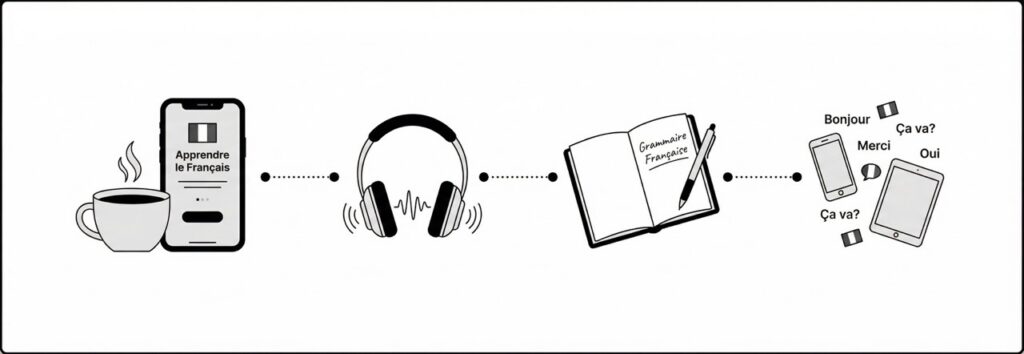
None of these methods works as well alone as they do together. Here’s what a realistic daily French routine looks like—about 45 minutes total, broken into pieces that fit around a normal life:
Morning (10 min): One Duolingo or Babbel lesson while drinking coffee. Quick, structured, gets your brain into French mode.
Commute or lunch (20 min): One episode of a French podcast (InnerFrench, Coffee Break French) or 20 minutes of a French Netflix show with smart subtitles adapted to your level.
Evening (10 min): Write 3–5 sentences in a French journal. Or shadow a scene from the show you watched. Or do a 10-minute iTalki session.
Throughout the day (passive): Phone in French, social media in French, grocery list in French.
Weekend (bonus): Watch a full French movie. Read a chapter of a graded reader. Have a 30-minute tutor session.
That’s it. No three-hour study marathons. No guilt when you miss a day. Just enough French, every day, that your brain can’t help but learn.
FAQ
How long does it take to learn French? The U.S. Foreign Service Institute estimates about 600 hours of study for English speakers to reach professional working proficiency in French. At 45 minutes a day, that’s roughly 2 years. But you’ll start having basic conversations much sooner—most learners can handle simple interactions after 3–6 months of consistent practice.
What is the best app for learning French? There’s no single best app. Duolingo is great for building a daily habit. Babbel is better for structured grammar. Anki is the most powerful for vocabulary. Bingy turns Netflix into personalized practice. The best approach is combining a study app with an immersion tool—not relying on any single one. For a detailed comparison, see our honest guide to the best language learning apps for Netflix.
Can I learn French just by watching Netflix? You can build strong listening comprehension and absorb significant vocabulary, but Netflix alone won’t teach you to speak, write, or understand grammar rules. It’s an exceptional input tool that works best when combined with speaking practice and some structured study. For the full approach, see our complete guide to learning a language with Netflix.
Is French hard to learn for English speakers? French is actually one of the easier languages for English speakers. About 45% of English vocabulary has French origins (thanks to the Norman conquest), so you already know more French words than you think. The main challenges are pronunciation (nasal vowels, the French R, silent letters), gendered nouns, and the gap between written and spoken French. All of these respond well to consistent immersion.
Should I learn French grammar before trying to speak? No. Speak from day one, even badly. Grammar study and speaking practice should happen in parallel, not sequentially. If you wait until your grammar is “ready,” you’ll wait forever. The mistakes you make while speaking are actually how your brain calibrates—each correction sticks better than ten grammar exercises.
How many French words do I need to know to have a conversation? About 1,000 words covers roughly 85% of everyday French conversation. About 3,000 words gets you to 95%. Focus on the most frequent words first—the top 300 French words account for about 65% of all spoken French. Quality over quantity: knowing 500 words well (including how to use them in sentences) beats knowing 2,000 words from flashcards that you can’t actually deploy in conversation.
The Bottom Line
Learning how to learn French is almost as important as learning French itself. The method matters. And the method that works is never just one thing—it’s a combination of daily immersion, smart tools, comprehensible input, speaking practice, targeted pronunciation work, strategic grammar study, and micro-immersion habits that make French a part of your life rather than a task on your to-do list.
Start small. Be consistent. Trust that the hours add up even when it doesn’t feel like progress. And when you’re ready to turn your Netflix habit into French practice, try Bingy’s free vocabulary test to get subtitles that adapt to exactly where you are right now.
Leave a Reply