
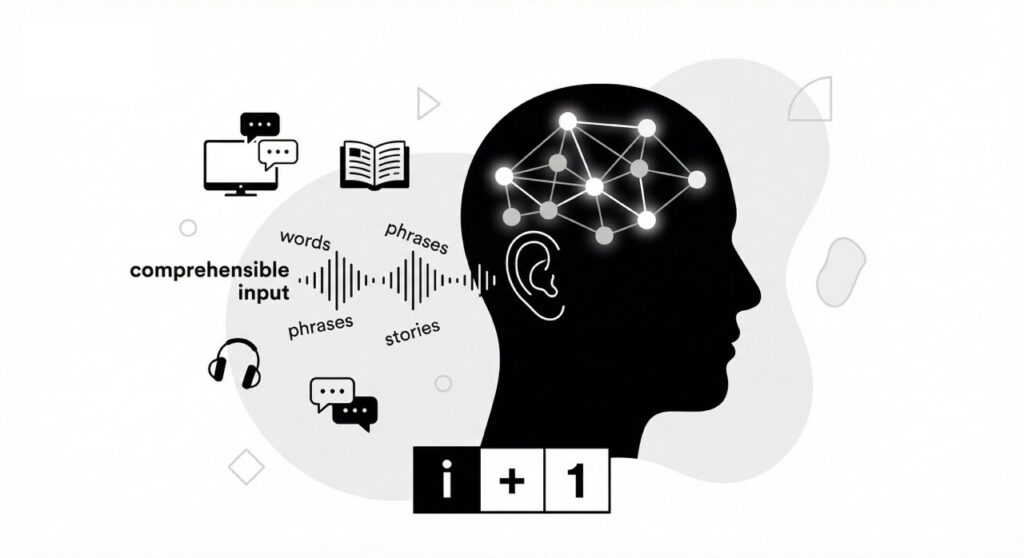
You’ve probably had this experience. You’ve been studying a language for months—flashcards, grammar exercises, conjugation tables—and then someone speaks to you at normal speed and you understand almost nothing. Your knowledge is there, locked inside your head, but it doesn’t fire fast enough. The words don’t connect to meaning the way they do in your native language.
Now think about a different experience. You’re watching a show in your target language. You don’t understand everything, but you follow the story. You catch phrases you recognize. Occasionally, a word you’ve never formally studied just… makes sense, because the context makes it obvious. Nobody taught you that word. You absorbed it.
That second experience is comprehensible input in action. It’s not a hack, not a shortcut, and not a new idea. It’s the most researched theory in language acquisition, backed by decades of evidence, and it explains why some learners progress fast while others grind through textbooks and plateau.
This guide explains what comprehensible input actually is, what the science says, how to use it in practice, where it falls short, and how to build a daily routine around it—whether you’re learning French, Spanish, Japanese, or any other language.
What Comprehensible Input Actually Means
The concept comes from linguist Stephen Krashen, who introduced it in the early 1980s as part of his theory of second-language acquisition. The core idea is disarmingly simple:
You acquire language when you understand messages.
Not when you memorize rules. Not when you drill conjugations. Not when you repeat phrases in a vacuum. You acquire language when you comprehend what someone is saying or writing—even if you don’t catch every word.
Krashen formalized this as the i+1 hypothesis: i represents your current level of competence, and +1 represents language that’s just slightly beyond it. When you encounter input at that level—challenging enough to push you forward, but comprehensible enough that you can follow the meaning—your brain absorbs the new patterns naturally.
Think about how children learn their first language. Nobody sits a toddler down and explains subject-verb agreement. Instead, the child hears thousands of hours of speech in context—parents pointing at objects, describing actions, reacting to situations—and the brain gradually maps sounds to meanings, then meanings to patterns, then patterns to grammar. All without a single flashcard.
Comprehensible input argues that second-language acquisition works the same way. Not identically (adults have advantages children don’t, and vice versa), but through the same fundamental mechanism: understanding messages in context, repeatedly, over time.
The Science: What Research Actually Shows
Comprehensible input isn’t just a nice theory. It’s been tested extensively, and the results are consistent—even if the picture is more nuanced than some enthusiasts admit.
The evidence in favor
Free voluntary reading studies. Krashen compiled decades of research showing that people who read extensively in a second language outperform those who receive direct grammar instruction—on grammar tests, vocabulary tests, writing assessments, and even spelling. The effect is robust across languages and age groups. Reading works not because it’s a grammar exercise, but because it provides massive amounts of comprehensible input in a low-anxiety context.
French immersion programs in Canada. Students enrolled in French immersion programs—where subjects like math and science are taught in French rather than about French—consistently develop strong listening and reading comprehension. Their receptive skills approach native-speaker levels. This is comprehensible input at scale: thousands of hours of meaningful, context-rich French.
The Dreaming Spanish experiment. The YouTube channel Dreaming Spanish has built an entire platform around comprehensible input for Spanish learners. Their community of thousands tracks hours of input, and the progression data is striking: learners who accumulate 300+ hours of comprehensible listening reliably reach conversational comprehension, and those who hit 1,000+ hours report comfortable fluency. These aren’t lab results—they’re real-world outcomes from a large community.
Subtitle studies. A meta-analysis of 26 experimental studies found that watching content with subtitles in the target language produces meaningful learning gains across listening, vocabulary, and reading skills (effect size d = 0.69). Researchers at MIT found that adaptive subtitle systems—which adjust translations based on the learner’s vocabulary—led to learners defining over twice as many new words compared to standard bilingual subtitles.
The honest caveats
Output skills lag behind. The Canadian immersion research also revealed a critical limitation: students who received massive comprehensible input developed excellent receptive skills (listening and reading) but maintained non-native patterns in their production (speaking and writing). They could understand French perfectly but still made systematic errors when speaking. This is the core of Merrill Swain’s Output Hypothesis—that comprehensible input alone isn’t enough for full grammatical accuracy in production.
i+1 is hard to define precisely. What exactly is “one step above your current level”? Krashen never provided a way to measure this objectively, which makes the theory hard to test in a strict scientific sense. In practice, most researchers and teachers interpret it loosely as “mostly comprehensible with some new elements”—which is useful but vague.
Passive consumption isn’t enough. More recent neurolinguistic research argues that language acquisition is an active, embodied process. Simply hearing comprehensible input without engagement, attention, or emotional investment produces weaker results than engaged, interactive exposure. The input matters—but so does what your brain does with it.
The honest conclusion: comprehensible input is the primary driver of language acquisition. The evidence for that is overwhelming. But it’s not the only thing you need. Speaking practice, interaction, and some explicit knowledge of grammar all play supporting roles that input alone can’t fully replace.
Acquisition vs. Learning: Why This Distinction Matters
Krashen draws a sharp line between two processes that most people conflate:
Acquisition is subconscious. It’s what happens when you absorb language through exposure—the way you “just know” that “I goed to the store” sounds wrong in English, even if you can’t name the grammatical rule. Acquired knowledge is fast, automatic, and available in real-time conversation.
Learning is conscious. It’s what happens when you study a grammar rule and can explain it on a test. Learned knowledge is slow, deliberate, and requires you to think about language rather than through it. It acts as a “monitor”—you can use it to self-correct after you’ve spoken, but it can’t generate fluent speech on its own.
This distinction matters enormously for how you spend your time. If acquisition is the primary driver of fluency, then the bulk of your time should go toward activities that promote acquisition: listening, reading, watching, engaging with meaningful content in context. Grammar study has its place—but as a supporting tool, not the main event.
Most language courses are structured around learning: grammar rules, vocabulary lists, fill-in-the-blank exercises, translation drills. These activities teach you about the language. Comprehensible input teaches you the language itself—the patterns, rhythms, and intuitions that allow you to understand and respond without consciously processing rules.
The practical implication is radical: you should spend most of your study time consuming content you can mostly understand, not drilling rules you can recite but can’t deploy.
How to Use Comprehensible Input in Practice
The theory is clean. The practice is messier, because finding content at exactly the right level is genuinely hard. Here’s how to do it across different media.
Listening: TV shows, podcasts, and YouTube
TV shows and movies are the richest source of comprehensible input available to most learners. You get language embedded in visual context—facial expressions, body language, settings, tone of voice—which helps your brain decode meaning even when individual words are unclear. Netflix alone offers content in over 60 languages, making it the largest library of authentic input most learners will ever need.
The key is matching the content to your level. If you understand less than about 60% of what’s being said, the input isn’t comprehensible—it’s noise. If you understand 95%+, it’s too easy to push you forward. The sweet spot is roughly 70–90% comprehension: you follow the story and get the gist, but you’re encountering new words and structures in every scene.
For a practical guide on how to use Netflix as a comprehensible input machine—including the subtitle strategy that makes it work—see our complete guide to learning a language with Netflix.
Tools can help bridge the gap. Bingy adapts subtitles to your vocabulary level automatically—keeping the target language when you can handle it, switching to your native language when you can’t, and translating individual blocking words inline. This turns any Netflix show into personalized comprehensible input without you having to manually find content at your exact level. For the science behind this approach, see our piece on the smart subtitles method.
Podcasts for learners are designed specifically as comprehensible input. For French, InnerFrench speaks slowly and clearly about interesting topics. For Spanish, Dreaming Spanish offers hundreds of hours of free content graded by level. Easy French and Easy German film real street interviews with on-screen subtitles. The Comprehensible Input Wiki maintains a curated directory of CI resources for dozens of languages.
Reading: graded readers and extensive reading
Reading is the most underrated source of comprehensible input. It gives you complete control over pace (you can re-read a sentence, slow down, speed up), exposes you to vocabulary and grammar in context, and builds spelling and writing instincts simultaneously.
Graded readers are books written for specific proficiency levels (A1 through C1). They use controlled vocabulary and progressively complex grammar, so you can read entire stories without needing a dictionary on every page. Publishers like CLE International (French), Edinumen (Spanish), and Easy Readers (multiple languages) produce excellent series.
Extensive reading means reading a lot at a comfortable level—prioritizing quantity and enjoyment over difficulty. The goal isn’t to challenge yourself with every sentence; it’s to read so much that patterns become automatic. Research consistently shows that extensive reading produces larger vocabulary gains than intensive study of smaller texts.
The rule of thumb: if you’re looking up more than 2–3 words per page, the text is too hard for extensive reading. Drop down a level. The confidence of understanding full pages without help is itself a powerful acquisition signal.
The 80% rule
Across all media—listening, reading, watching—aim for content where you understand about 80% naturally. This is the practical translation of i+1. At 80% comprehension, your brain is constantly filling in gaps from context, which is exactly the mechanism that drives acquisition. Below 60%, you’re mostly guessing. Above 95%, you’re coasting.
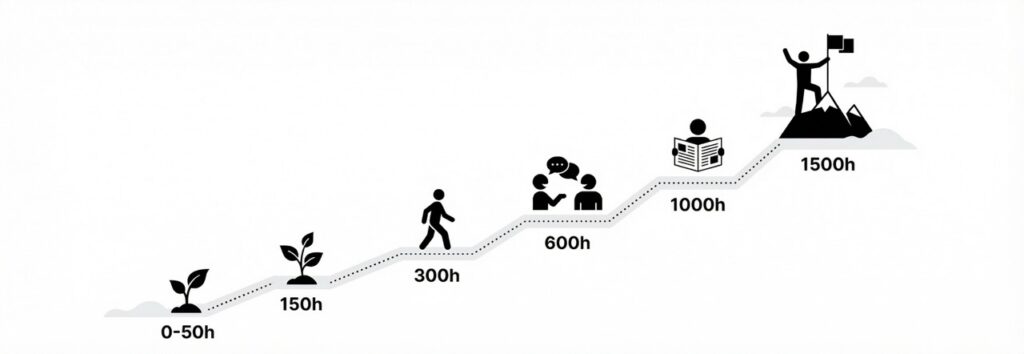
The Stages of a Comprehensible Input Journey
How much input do you actually need? The honest answer is: a lot. But the progression is predictable, and the milestones are real.
The Dreaming Spanish community has tracked thousands of learners and established rough benchmarks that hold across languages (adjusted for language distance):
| Hours of input | What you can typically do |
|---|---|
| 0–50 | Recognize common words, understand very simple sentences with visual support |
| 50–150 | Follow simplified content designed for learners, catch the topic of simple conversations |
| 150–300 | Understand patient speakers on familiar topics, follow the plot of simple shows |
| 300–600 | Understand people speaking at normal speed on everyday topics |
| 600–1,000 | Comfortable with most daily conversation, catch humor and implied meaning |
| 1,000–1,500 | Overall effective use of the language, handle complex topics, enjoy native media naturally |
These numbers assume input in a related language (e.g., English speaker learning French or Spanish). For distant languages (e.g., English speaker learning Japanese or Mandarin), multiply by roughly 2x.
The critical insight: progress is not linear. The first 100 hours often feel unproductive—you understand fragments, you miss most of what’s said, and improvement is invisible. Then somewhere around 200–400 hours, things start clicking rapidly. Words you’ve encountered dozens of times suddenly lock into place. Sentences you couldn’t parse before become transparent. This is the “snowball phase,” and every input-based learner describes it.
The danger zone is hours 50–200. This is where most people quit, because the effort-to-results ratio feels terrible. Understanding this is normal helps you push through it.
Where Comprehensible Input Falls Short (And What to Add)
Comprehensible input is the engine of language acquisition. But an engine isn’t a car. Here’s what CI alone doesn’t do well, and what you should add.
Speaking and writing don’t develop automatically
This is the most important limitation. You can accumulate 1,000 hours of comprehensible input and develop extraordinary listening and reading skills—while still struggling to form sentences out loud. Receptive skills (understanding) and productive skills (producing) rely on partly different brain circuits. Input builds one; output practice builds the other.
The fix: Start speaking earlier than pure CI theory recommends. You don’t need to wait until you’re “ready”—even basic, halting output practice forces your brain to activate vocabulary and grammar in a different way. iTalki tutors, language exchange apps like HelloTalk and Tandem, or simply talking to yourself in the target language all work. Even 10 minutes a day of speaking practice, combined with hours of input, produces dramatically better results than input alone.
Some grammar patterns resist pure acquisition
Most grammar emerges naturally from sufficient input. But some patterns—especially those that differ sharply from your native language and occur infrequently—can take extremely long to acquire through input alone. A small amount of explicit grammar study (10–15 minutes, focused on a specific pattern, followed by noticing that pattern in your input) can dramatically accelerate acquisition of these stubborn structures.
The fix: Don’t study grammar instead of consuming input. Study grammar alongside it. Learn a rule, then go watch a show and listen for examples. The rule gives you the pattern; the input gives you the intuition. For a practical grammar strategy, see our guide to learning French.
Motivation and engagement matter more than volume
A common trap in the CI community is treating input hours as a scoreboard: “I did 500 hours, why am I not fluent?” The quality of your engagement matters as much as the quantity. Zoning out in front of a show with target-language audio while scrolling your phone doesn’t count as comprehensible input—your brain isn’t processing the language. Engaged, attentive viewing of a show you genuinely enjoy, even for 20 minutes, is worth more than 2 hours of background noise.
The fix: Pick content you actually want to consume. If you hate crime dramas, don’t force yourself to watch them because someone said they’re “good for learning.” Watch the rom-com. Listen to the podcast about cooking. Read the comic book. The content that keeps you coming back tomorrow is the best content for acquisition.
Building a Daily Comprehensible Input Routine
Here’s what a practical CI-based routine looks like. It’s designed to be sustainable—not heroic—because the whole point of comprehensible input is that it works through consistent exposure over time, not through willpower-intensive study sessions.
Morning (10 min): Listen to a podcast episode at your level while getting ready or commuting. Don’t worry about understanding everything—focus on catching the main idea.
Midday (20 min): Watch one episode of a show in your target language with target-language subtitles. If you’re learning French, try something from our French Netflix guide. Use Bingy if the subtitles feel too hard without support.
Evening (15 min): Read a graded reader or a simple article in your target language. Keep it easy enough that you don’t need a dictionary for most pages.
Bonus (5 min): One short speaking exercise—describe your day, shadow a scene you watched, or send a voice message to a language exchange partner.
Total: ~50 minutes. At this pace, you’ll hit 300 hours of input in about a year—the threshold where most learners report comfortable comprehension of normal speech. That’s not a gimmick. That’s how language acquisition actually works: slowly, then all at once.
FAQ
What is comprehensible input in simple terms? It’s language you can mostly understand from context, even if you don’t know every word. When you watch a show and follow the plot despite missing some dialogue, or read a book and get the meaning without translating every sentence—that’s comprehensible input. Your brain uses the context to figure out new words and grammar patterns naturally.
How is comprehensible input different from just watching TV in another language? The key difference is comprehension. Watching a show where you understand 10% is not comprehensible input—it’s noise. Comprehensible input requires that you understand most of what’s happening (around 70–90%) so your brain can use context to decode the rest. The right show at the right level with the right subtitle strategy is comprehensible input. The wrong show is just background noise.
Do I need to study grammar if I use comprehensible input? For most grammar patterns, no—they emerge naturally from enough exposure. But some structures (especially those that differ sharply from your native language) benefit from brief explicit study. The ideal approach is to combine massive input with small, focused grammar sessions: learn a pattern, then notice it in your input. Don’t choose between grammar and CI—use both, with CI as the primary activity.
How many hours of comprehensible input do I need to become fluent? For related languages (e.g., English speaker learning French or Spanish), roughly 600–1,000 hours of engaged input produces comfortable conversational comprehension. For distant languages (Mandarin, Japanese, Arabic), expect 1,500–2,000+ hours. At 45 minutes per day, 1,000 hours takes about 3.5 years. These are rough estimates—individual results vary based on engagement quality, prior language experience, and how much output practice you add.
Is comprehensible input just for beginners? No. It’s the primary mechanism of language acquisition at every level. Beginners use simplified content (learner podcasts, graded readers, visual-heavy shows). Intermediate learners use authentic content with support (Netflix with target-language subtitles, novels at their level). Advanced learners consume native media without support—which is itself still comprehensible input, just at a higher level. You never “graduate” from CI; the content simply gets more complex as you progress.
Can I get comprehensible input from apps like Duolingo? Partially. Duolingo provides some comprehensible input through its listening exercises and stories, but the sentences are short, decontextualized, and designed for practice rather than immersion. Real comprehensible input comes from sustained, meaningful content—shows, podcasts, books, conversations—where language serves communication rather than testing. Apps are useful supplements, but they’re not the core of a CI-based approach.
The Bottom Line
Comprehensible input isn’t a method you try for a month to see if it works. It’s the foundational process through which human beings acquire language—first or second. The science behind it is robust, the practical results from communities like Dreaming Spanish are compelling, and the experience of actually doing it (watching shows, listening to podcasts, reading books in another language) is genuinely enjoyable.
The biggest shift it requires isn’t in your study habits. It’s in your definition of what “studying” means. If you’ve been trained to believe that language learning requires suffering through grammar drills and vocabulary lists, comprehensible input asks you to do something that feels almost too good to be true: spend your time consuming content you enjoy, in a language you’re learning, at a level you can mostly understand.
That’s not laziness. That’s acquisition. And it works.
If you want to turn Netflix into a daily source of comprehensible input adapted to your exact vocabulary level, try Bingy’s free vocabulary test. It takes 45 seconds, and it transforms any show into personalized i+1 content—automatically.
Leave a Reply