

Everyone says the same thing: “Just watch Netflix in your target language!” It sounds easy. It sounds fun. And honestly, it can work—but not the way most people do it.
The reality is that Netflix offers content in over 60 languages, making it one of the largest libraries of authentic, native-level material available to any language learner on the planet. You get real conversations, real accents, real slang, real emotions—everything a textbook struggles to deliver.
But here’s the problem: without a clear method, most people either zone out with native-language subtitles (learning almost nothing), or white-knuckle through target-language-only audio until they give up out of frustration.
This guide is different. It’s a complete, step-by-step method for turning Netflix into a genuine learning tool—based on what the research actually says, what experienced learners do, and what mistakes you should avoid. Whether you’re learning Spanish, French, Korean, German, or any other language, the principles are the same.
Does it actually work? What science says about learning languages with TV
Before we get into the how, let’s settle the big question: is watching TV in another language a real learning method, or just a comforting excuse to binge-watch?
Short answer: the science is genuinely encouraging—with some important caveats.
The theory behind it: comprehensible input.
Linguist Stephen Krashen’s “input hypothesis” is one of the most influential ideas in language acquisition. The core concept is simple: we acquire language when we understand messages that are slightly above our current level—what Krashen calls “i+1.” Not too easy (boring, no learning), not too hard (overwhelming, no comprehension). The sweet spot in between is where your brain picks up new vocabulary and grammar almost without you trying.
Netflix, when used correctly, is one of the best environments for hitting that sweet spot. You get language embedded in visual context—facial expressions, gestures, settings, tone of voice—which helps your brain decode meaning even when you don’t catch every word.
What the studies show
– A meta-analysis of 26 experimental studies found that using subtitles in second-language classrooms produces a meaningful positive effect on learning (effect size d = 0.69), across listening, vocabulary, and reading skills.
– A study published in PLOS ONE showed that just one hour of watching English-subtitled content led to significantly improved listening comprehension among intermediate learners.
– Researchers at MIT tested an adaptive “smart subtitles” system and found that learners correctly defined over twice as many new words compared to those using standard bilingual (dual) subtitles—with the same viewing time and equal comprehension.
The honest caveat
Netflix alone will not make you fluent. It’s an input tool—exceptional for building listening skills, absorbing vocabulary in context, and developing an intuitive feel for the language. But it doesn’t replace output practice: speaking, writing, making mistakes, and getting corrected. Think of Netflix as the engine of your daily exposure, not the whole vehicle.
The subtitle strategy that actually works
This is the most important section of this guide. How you configure your subtitles determines whether Netflix is a learning tool or just entertainment you happen to feel guilty about.
The three subtitle modes (and when to use each one)
Native-language subtitles (e.g., English subtitles while listening to Spanish audio)
When to use: Your very first session with a difficult show, or when you need a “story break” to just enjoy the plot. When to stop: As soon as possible. Your eyes will always take the easy route—you end up reading the show instead of listening to it. Research consistently shows this mode develops reading speed in your native language more than anything else.
Target-language subtitles (e.g., Spanish subtitles while listening to Spanish audio)
When to use: This is the sweet spot for most learners most of the time. You hear the language and see it written, which builds the connection between sound and spelling. When it gets hard, the written words give you just enough of a lifeline to keep following the story.
No subtitles at all
When to use: For content you’ve already watched once, or for shows clearly below your level. This is pure listening practice. When to avoid: If you understand less than 70% without subtitles, you’re probably just training yourself to tune out—not to listen.
The progressive method: three phases
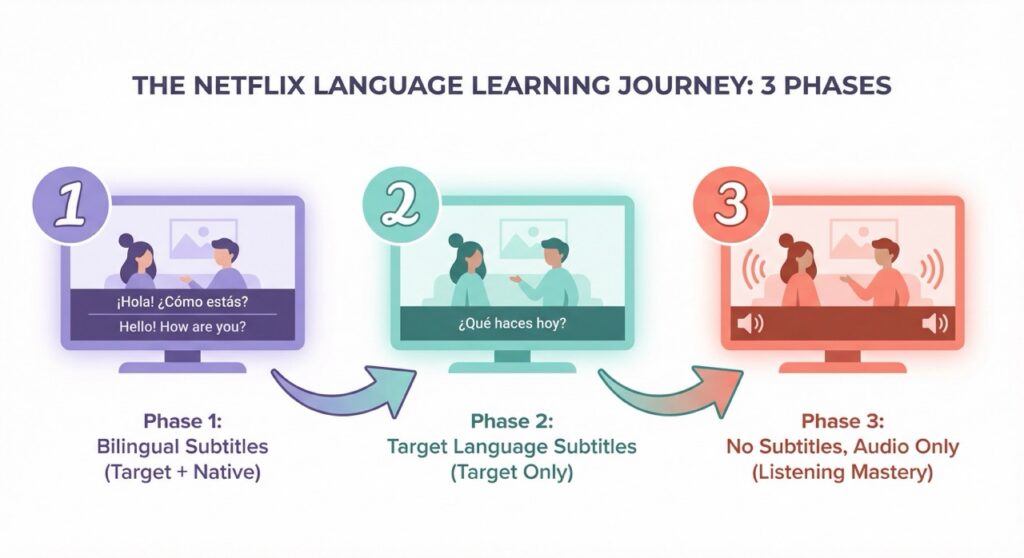
Phase 1 (weeks 1–4): Target-language audio + target-language subtitles + occasional help. The goal isn’t to understand everything. It’s to get your ears used to the sounds and rhythms while you grab onto words you recognize. When a sentence is completely opaque, having a way to get a quick translation (through a tool, or by switching subtitle language briefly) keeps you in the story. Some tools go further: for instance, Bingy adapts subtitles to your vocabulary level automatically, showing the target language when a subtitle is within reach and switching to your native language only when it’s not—so you stay in the flow without configuring anything.
Phase 2 (weeks 5–12): Target-language audio + target-language subtitles only. Now you’re building tolerance for ambiguity. You won’t understand everything, and that’s the point. Your brain starts filling in gaps through context, and that’s exactly how natural acquisition works. This phase feels uncomfortable at first, but it’s where real progress happens.
Phase 3 (month 3+): Target-language audio, no subtitles (on familiar content). Rewatch a show you’ve already seen with subtitles. You already know the plot, so your brain can focus entirely on parsing the audio. This is where listening comprehension jumps dramatically.
How to choose the right show for your level
The single biggest reason people fail at “learning with Netflix” isn’t laziness or lack of tools—it’s picking the wrong show. If the content is too far above your level, you’ll spend the entire time drowning instead of learning. If it’s too easy, you won’t encounter anything new.
The five-minute test
Watch five minutes of a show without subtitles. Ask yourself:
– Can I tell who’s talking to whom?
– Do I get the general situation (are they arguing? joking? planning something)?
– Do I recognize at least some individual words?
If you answered yes to at least two of these, the show is in your learning zone. If it was pure noise, pick something easier. You’re building a habit, not proving something.
Recommendations by level
Beginner (A1–A2): Keep it slow, visual, and repetitive
At this stage, you need shows where the dialogue is simple, the pace is slow, and the visual context practically tells you what’s being said. Repetition is gold—recurring settings and phrases help words stick.
– Children’s shows and simple animation
– Cooking shows and reality TV (visual context does the heavy lifting)
– Educational series like Extra (available in Spanish, French, German, and English—designed specifically for learners)
Intermediate (B1–B2): The sweet spot
This is where Netflix really shines. You know enough to follow a plot but still encounter plenty of new vocabulary and grammar in every episode.
– Sitcoms and romantic comedies (everyday dialogue, predictable structure)
– Documentaries (clear narration, specific but visual vocabulary)
– Light dramas with modern, conversational language
Advanced (C1–C2): Stretch yourself
At this level, you need content that challenges your ear with speed, slang, overlapping dialogue, and cultural references.
– Thrillers and political dramas (fast speech, complex vocabulary)
– Stand-up comedy (slang, wordplay, cultural humor—arguably the hardest content to understand)
– Art-house films and auteur series
Top Netflix shows by language
Spanish: Elite, La Casa de Papel (Money Heist), Club de Cuervos, Las Chicas del Cable, Valeria
French: Lupin, Dix Pour Cent (Call My Agent), Plan Coeur (The Hook Up Plan), Arsène Lupin, Family Business
German: Dark, How to Sell Drugs Online (Fast), Biohackers, Barbaren (Barbarians), Kleo
Korean: Crash Landing on You, Reply 1988, My Love from the Star, Extraordinary Attorney Woo
Japanese: Terrace House, Midnight Diner, Alice in Borderland, The Makanai
Portuguese: 3%, Sintonia, Cidade Invisível (Invisible City), Bem-Vinda a Quixeramobim
Italian: Baby, Suburra, Summertime, Tutto Chiede Salvezza
The step-by-step Netflix learning routine
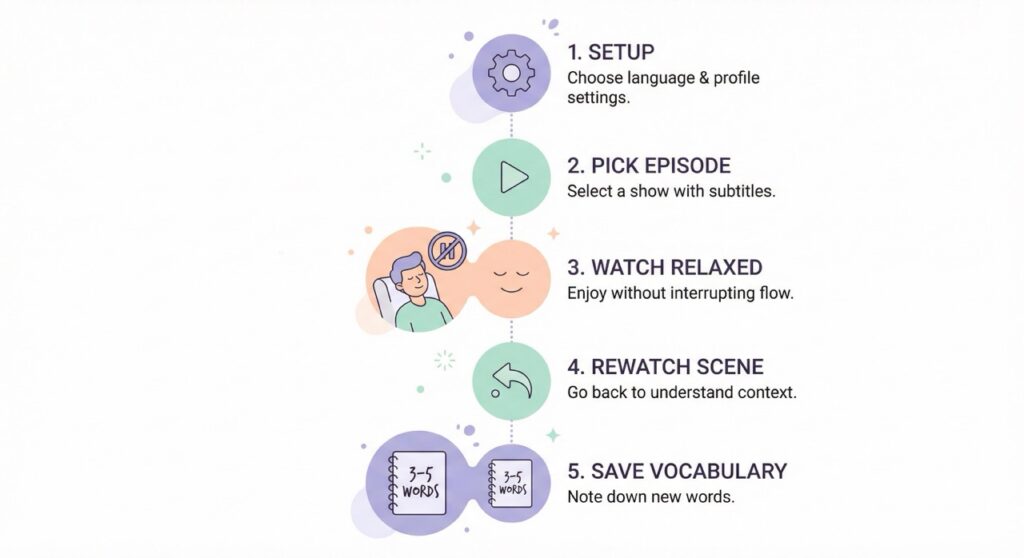
You don’t need a two-hour “study session.” The best Netflix routine is short, regular, and surprisingly gentle. Here’s a version you can start tonight.
Step 1: One-time setup (5 minutes)
– Create a dedicated Netflix profilefor language learning. This keeps your recommendations in the target language without messing up your regular feed.
– Switch the interface language of that profile to your target language. Even the menus become mini lessons.
– Install a subtitle tool if you want extra support (see the tools section below). Not required, but it makes Phase 1 significantly smoother.
Step 2: Pick an episode (2 minutes)
– Apply the five-minute test from the section above.
– Prefer series over movies. Short episodes (20–40 minutes) fit into a daily routine. Movies are better for weekend deep dives.
– If in doubt, start with a show you’ve already seen in your native language—you already know the plot, so you can focus on the language.
Step 3: Watch 15–20 minutes with one rule: don’t pause for every unknown word
This is where most “Netflix learners” accidentally sabotage themselves.
Pausing feels productive. But every pause forces your brain to switch from “story mode” (where language acquisition happens naturally) to “problem-solving mode” (where you’re just translating). Do this repeatedly, and Netflix stops feeling like a show and starts feeling like homework. The flow state breaks, and with it, your motivation.
Instead: let the story carry you. If you miss a word, let the context fill in the gap. If you miss a whole sentence, that’s fine—you’ll hear similar structures again. Over time, the words that matter will come back often enough that your brain picks them up without you forcing it.
If a single word is truly blocking your understanding of an entire scene, then look it up—or use a tool that surfaces translations only when needed, so the story keeps moving.
Step 4: Rewatch one short scene (5 minutes, optional but powerful)
Pick a scene you enjoyed—two minutes is enough—and rewatch it.
The first time, your brain was busy decoding meaning. The second time, you already know what happens. That frees up mental bandwidth to notice things you missed: how a phrase is constructed, how a word is pronounced, what little connector words (“bien,” “quand même,” “eigentlich,” “pues”) people use to sound natural.
This is the concept of “narrow listening”—revisiting the same content to deepen your processing. It’s one of the most efficient things you can do, and it takes almost no extra time.
Step 5: Save 3–5 words or expressions (2 minutes)
Not 50. Not 20. Three to five.
Pick words or short phrases that feel genuinely useful—things you’ll hear again, things you could imagine using in conversation. Write them in a notebook, a notes app, or a flashcard tool like Anki.
The goal of this step is to end the session with a small, satisfying win—not a massive to-do list that makes you dread tomorrow’s episode.
Total time: about 25 minutes. Consistency beats intensity—every single time.
5 mistakes that waste your time
1. Watching with native-language subtitles and thinking you’re learning
This is the most common trap. It feels like immersion because you hear the foreign audio. But your brain always takes the path of least resistance: your eyes read the English (or French, or whatever your native language is), and your ears quietly tune out. You’re watching a subtitled show, not learning a language.
2. Picking a show that’s way too hard because it sounds impressive
“I’m going to watch Money Heist in Spanish on day one.” Noble intention, terrible idea. If you’re at A2 level and the show is full of rapid-fire slang, you’ll understand about 5% of the dialogue. That’s not a learning experience—it’s an exercise in frustration. Match the show to your level, not your ambition.
3. Pausing every 10 seconds to look up a word
Some pausing is fine. But when every subtitle becomes a dictionary lookup, you’ve turned Netflix into the world’s most expensive flashcard app. The story dies, the emotions vanish, and you lose the contextual learning that makes this method powerful in the first place.
4. Expecting results after three episodes
Language acquisition is slow and then suddenly fast. You’ll feel like nothing is happening for weeks—and then one day you’ll understand a sentence you’ve never studied, and it’ll feel like magic. The research suggests that noticeable improvements in listening comprehension start appearing after roughly 15–20 hours of exposure. That’s about 40 episodes of a 30-minute show. Stick with it.
5. Using Netflix as your ONLY method
Netflix is exceptional at building input skills: listening comprehension, vocabulary recognition, intuition for grammar and phrasing. But it doesn’t practice output : speaking, writing, forming sentences on your own. The most effective learners combine Netflix with at least some conversation practice—even 15 minutes a week with a tutor or language partner makes a huge difference.
Best tools to supercharge Netflix language learning
You don’t need a tool to learn with Netflix—the built-in subtitle options already work. But the right extension or app can make the experience significantly smoother, especially in the early stages.
Language Reactor (free / $5.95/mo for Pro)
The most established Netflix extension with over 2 million users. It provides dual subtitles (target + native language side by side), a popup dictionary when you hover over any word, auto-pause after each line of dialogue, and export to Anki for spaced repetition. Best for learners who want maximum control and like to study actively while watching.
Bingy (free vocabulary test / 7-day free trial / $34.99/year)
Takes a different approach: instead of showing everything and letting you manage it, Bingy adapts subtitles automatically to your level. After a quick vocabulary assessment, it knows roughly which words you already know, and adjusts in real time—keeping subtitles in the target language when you can handle them, switching to your native language when you can’t, and showing inline translations when just one word is blocking you. Best for learners who want to stay in the flow without tinkering with settings.
Lingopie (subscription, ~$12/mo)
Not a Netflix extension but a standalone streaming platform built for language learners. It has its own catalog of shows with clickable dual subtitles, auto-generated flashcards, grammar notes, and progress tracking. Best for learners who want an all-in-one experience and don’t mind a smaller content library.
Sabi (free Chrome extension)
Provides dual subtitles with interactive exercises that pop up while you watch—quizzes, fill-in-the-blank, and gamified rewards. Best for learners who like active testing and gamification during their viewing sessions.
Which one should you pick? It depends on your learning style. If you like control and active study, Language Reactor. If you want adaptive, hands-off support, Bingy. If you prefer a dedicated platform, Lingopie. If you want gamified practice, Sabi. Try them out (most offer free trials) and see what clicks.
How long does it take to see results?
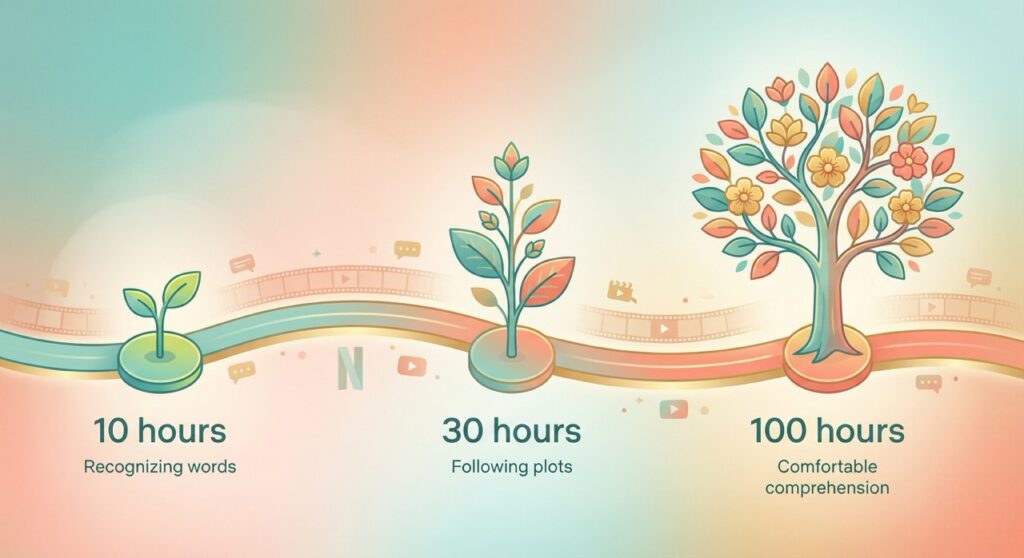
This is the question everyone asks and nobody answers honestly. So here’s a realistic timeline, assuming you watch about 20–30 minutes a day in your target language:
After ~10 hours (about 2–3 weeks): You start recognizing recurring words and common phrases. You can anticipate what a character is about to say in predictable situations. You’re not “understanding” yet, but you’re noticing — and that’s the first real sign of progress.
After ~30 hours (about 6–8 weeks): You follow the general plot of most scenes without subtitle support. You catch jokes occasionally. Individual words that you’ve encountered many times start “clicking” without conscious effort.
After ~100 hours (about 4–5 months): You understand most everyday dialogue. You catch humor, sarcasm, and subtext. You start noticing differences between characters’ speech styles. Watching becomes genuinely enjoyable, not just “educational.”
These numbers vary enormously depending on your starting level, how close your native language is to the target language, and whether you’re combining Netflix with other practice. But the pattern is consistent: it feels slow, then it feels sudden.
The golden rule: 20 minutes a day beats 3 hours on Sunday. Regularity is what builds the neural pathways. Intensity without consistency just builds frustration.
FAQ
Can you really learn a language just by watching Netflix?
You can build strong listening comprehension and absorb a significant amount of vocabulary, yes. Multiple studies confirm that watching subtitled content in a foreign language improves both listening and vocabulary skills. But “just watching” won’t develop your speaking or writing. For well-rounded fluency, combine Netflix with conversation practice and some structured study.
Should I use subtitles in my language or the target language?
Target language, as soon as you can manage it. Native-language subtitles feel comfortable but train your reading, not your listening. Target-language subtitles create a bridge between what you hear and what you see, reinforcing both skills at once.
What is the best Netflix show to learn Spanish? French? German?
There’s no single best show—it depends on your level. For Spanish beginners, try Extra en Español or Club de Cuervos. For French, Dix Pour Cent or Plan Coeur. For German, How to Sell Drugs Online (Fast) or Biohackers. The key is to match the difficulty to your current level (see the recommendations by level above).
How many hours of Netflix do I need to watch to learn a language?
Expect to notice real improvements after 15–20 hours of active viewing. To reach comfortable comprehension of everyday dialogue, plan for 100+ hours over several months. This sounds like a lot, but at 20 minutes a day, you’ll hit 100 hours in about 10 months—and you’ll enjoy most of it.
What is the best Chrome extension for learning languages on Netflix?
Language Reactor is the most popular and feature-rich option for manual control. Bingy offers adaptive subtitles that adjust to your level automatically. Sabi adds gamified exercises. Each offers a free tier or free trial—try them and see which suits your style.
The bottom line
Netflix isn’t a magic pill for language learning. But when you use it with the right subtitle strategy, pick shows that match your level, and build a consistent daily habit, it becomes one of the most powerful—and enjoyable—tools available to any language learner.
The key is simple: target-language subtitles, content at your level, 20 minutes a day, and the patience to let your brain do its work. Everything else is optimization.
If you want subtitles that adapt to your level automatically, try Bingy’s free vocabulary test to get started.
Leave a Reply